Short answer
Our review methodology treats reviews as useful signals, not final proof. We separate product comfort reviews from retailer, delivery, warranty and service feedback, look for repeated patterns, and weigh review recency and detail quality. We do not use reviews as proof of body fit, long-term service outcomes or medical benefits, and we never rank brands, score products or publish star ratings of our own.
This page explains how MassageChairsTested.com evaluates massage chair reviews and how review signals feed into the rest of the site — buyer guides, brand pages, showroom guides, retailer trust content and warranty, service and delivery guidance. It is not a product review, a leaderboard or an affiliate page. It is the standard we hold ourselves to when we interpret what other people report. For the practical, shopper-facing version, see our guide on how to read massage chair reviews .
Our review philosophy
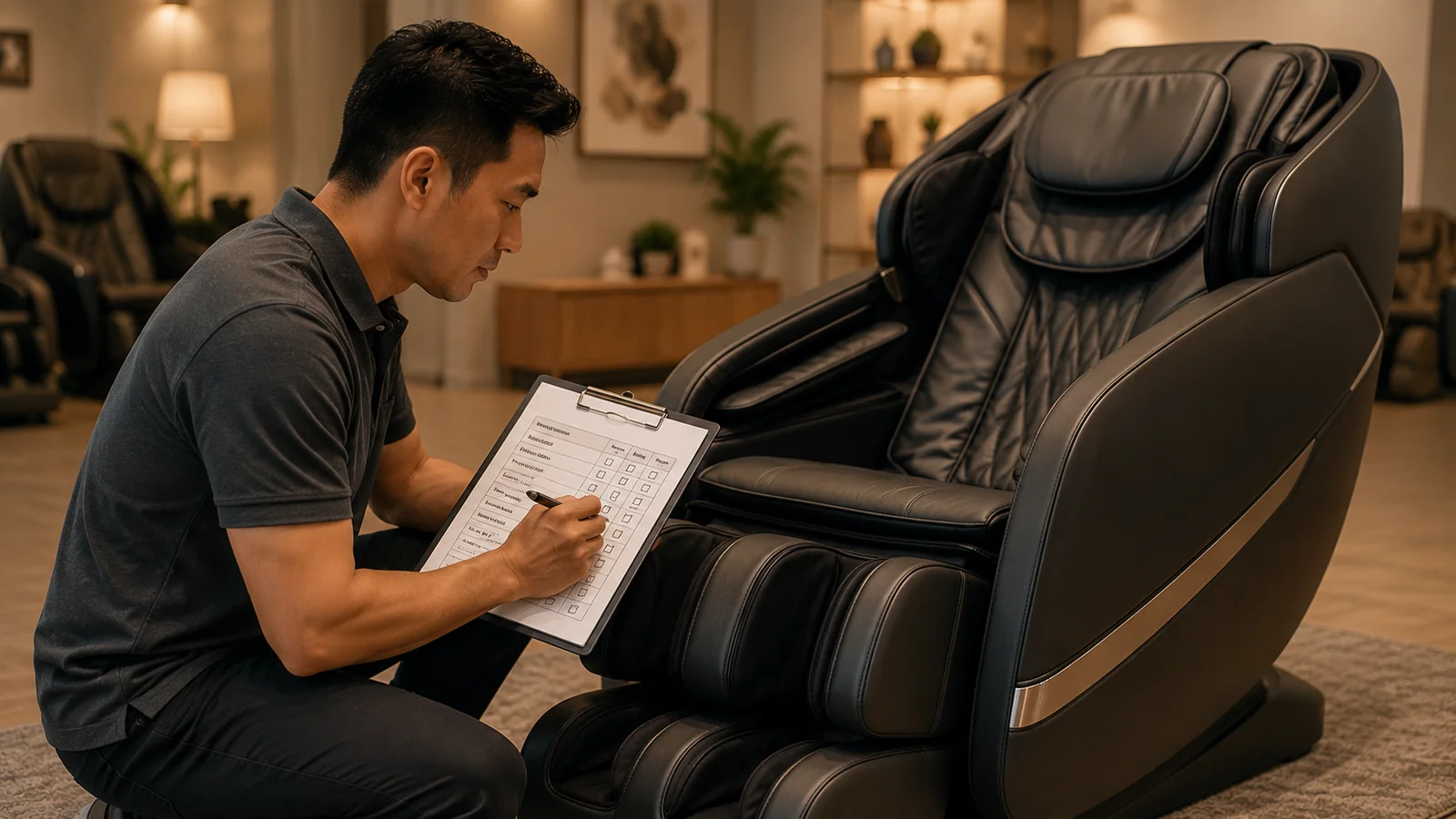
Massage chair reviews are genuinely useful, and they are easy to misread. A single number flattens hundreds of different experiences, the most emotional voices rise to the top, and a complaint about a late delivery can sink the score of a chair that feels wonderful. Our philosophy is simple: reviews narrow a decision, they do not settle it. We read them to find honest patterns and real questions, not to manufacture certainty.
Because comfort and body fit are personal and physical, no review — however glowing — can confirm a chair will suit your body. So we treat reviews as one input among several, alongside showroom testing, written warranty terms, retailer transparency and clear delivery and service answers. The goal of this methodology is to reduce buyer risk, not to replace your own judgment with ours.
Our review principles
- Reviews are signals, not proof. They suggest; they do not guarantee.
- Patterns beat single voices. One review is a story; many saying the same thing is evidence worth weighing.
- Separate what is being reviewed. Product, retailer, delivery, warranty and service answer different questions.
- Recency and detail matter. Recent, specific feedback describes what you would actually buy today.
- Limitations stay visible. We say plainly what reviews cannot tell you, including body fit and health outcomes.
- No fake certainty. We do not turn review signals into rankings, scores or star ratings.
- Review methodology
- The consistent way we read and weigh massage chair reviews — what we look at, what we separate, and what we refuse to treat as proof.
- Review signal
- A clue a review offers about a chair, a seller or an experience. Useful for narrowing choices, never a guarantee on its own.
- Review pattern
- The same observation repeated across many independent reviews. A pattern carries more weight than any single glowing or angry post.
- Review recency
- How recently a review was written. Models, sellers and support teams change, so newer feedback usually describes what you would actually buy now.
- Verified purchase
- A marker that the reviewer actually bought the item. It filters out some fake or incentivized reviews, but it is not a guarantee of honesty.
- Star rating
- A single averaged number standing in for many different experiences — a fast signal that hides the spread of opinion behind it.
- Anecdotal evidence
- One person’s reported experience. Useful for context, but not proof that the same will happen for you — especially for any health claim.
What we evaluate in reviews
When we read a body of massage chair reviews, we organize what we see into consistent signals so coverage stays comparable from one piece to the next. These are descriptive cues we look for — not scores, and not a rating we assign to any product.
- Review detail qualitySpecific, first-hand detail over vague, one-line praise or anger.
- Review recencyHow recent the feedback is, and whether the average is drifting.
- Repeated patternsThe same point raised independently by many reviewers.
- Exact model referencesWhether a review names the specific model, not just the brand.
- Verified-purchase contextA verified tag where available, read as a filter, not a guarantee.
- Showroom experienceComments on testing access, staff guidance and pressure.
- Delivery experienceShipping, damage, setup and white-glove handling.
- Service & warranty experienceHow claims, repairs and parts support actually went.
- Owner responsesWhether the seller replies constructively to problems.
- Claim languageWhether reviews repeat medical-sounding claims as if proven.
These signals inform how we describe a category. They are never combined into a numeric score or a ranking.
Product reviews vs retailer reviews
One of the most common ways reviews mislead is by blurring what is being reviewed. A frustrated buyer often rates the product one star because of a delivery or service failure that has nothing to do with how the chair feels — and a smooth buying experience can lift a chair that is only average to sit in. Untangling these tells you what each comment is actually evidence of.
- Product reviewsHow the chair itself feels and performs day to day.
- Retailer reviewsHow the seller guides, prices and handles problems.
- Delivery & service reviewsHow delivery, setup and after-sale support went.
- Product review
- Feedback about the chair itself — comfort, intensity, controls, noise and reliability over time.
- Retailer review
- Feedback about the seller — guidance, transparency, pricing clarity and how problems are handled.
- Delivery review
- Feedback about getting the chair into your home — shipping, damage, setup and white-glove handling.
- Warranty review
- Feedback about coverage in practice — how a claim was handled, and whether terms matched the promise.
- Service review
- Feedback about after-sale support — repairs, parts availability and response when something breaks.
| Review type | Can help with | Does not tell you |
|---|---|---|
| Product review | Comfort impressions, pressure and intensity, controls, noise, exact-model issues | Whether the seller is honest or service is reliable |
| Retailer review | Staff guidance, showroom testing, pricing and financing transparency, support | Whether a chair will physically suit your body |
| Delivery & service | Delivery experience, setup, warranty claims, repair response | How the massage actually feels day to day |
When a review mixes all three, read each sentence as separate evidence rather than one combined verdict.
Delivery, warranty and service review signals
Massage chairs are heavy, mechanical and expensive, so the ownership experience can matter as much as the massage. Reviews about delivery, warranty and service often reveal the parts of a purchase you cannot see in a showroom — and for a high-ticket buy, repeated problems here deserve real weight.
- Delivery delaysLong waits, missed windows or poor communication.
- Damaged deliveryChairs arriving dented, scuffed or incomplete.
- Setup experienceHow straightforward assembly and placement were.
- White-glove commentsWhether in-room delivery and setup matched the promise.
- Service responseHow quickly and helpfully support replied.
- Parts supportWhether parts were available and replaced without drama.
- Warranty claim experiencesHow a real claim was actually handled.
- Unresolved complaintsRepeated issues the seller never seems to close out.
How we treat star ratings
A star rating is a fast signal and a poor verdict. A high average can hide a cluster of service failures, and a low one may reflect a single delivery problem rather than the chair. We read the spread behind the number — how many reviews there are, where the low scores cluster, and whether recent feedback echoes older feedback — and we never let a star count become a ranking. We publish no ratings of our own.
| What you are reading | A star average shows | Review quality shows |
|---|---|---|
| Overall picture | One number for everyone | The spread of very different experiences |
| Why people rate low | Hidden inside the average | The actual failure modes to ask about |
| How recent | Often undated in the headline | Whether feedback is current |
| Product vs service | Blended together | Which signal a comment really is |
| Manipulation risk | Easy to inflate | Bursts and generic praise become visible |
A 5.0 from a handful of reviews tells you far less than a 4.3 from hundreds. Volume and shape matter more than a tenth of a star.
How we handle Google, marketplace and retailer reviews
Review source matters, because different platforms answer different questions. We read each for what it is genuinely good at and discount it where it is weak — without over-focusing on any single platform.
Google reviews
Usually attached to a place, so they reveal showroom and local experience — staff, pressure and follow-through — more than the chair itself.
Marketplace reviews
Can reveal product, delivery and seller patterns at volume, but mix models and sellers, so read for specifics and verified context.
Retailer website reviews
May be useful, but need context: curation and selection vary, so they are a starting point rather than the final word.
Manufacturer testimonials
Brand-published praise is marketing, not an independent review pattern, and we treat it accordingly.
Across every source, we favour recent, detailed, independent feedback and look for the same observation repeated by many people. A wall of short five-star posts is weaker evidence than a handful of specific, honest accounts.
How we handle brand and model reviews
Brand reviews are broad; model reviews are specific. A brand can make an excellent chair and an underwhelming one, so we are careful not to let one model’s reputation stand in for an entire line — or the reverse. Exact model matters, and older reviews may describe a version that no longer exists.
| Consideration | Brand reviews | Model reviews |
|---|---|---|
| Scope | Broad impression across many products | Specific to one chair |
| Specificity | General reputation and support | Fit, feel, features and exact-model issues |
| Outdated risk | Less tied to a current model | Older reviews may describe a discontinued version |
| Best paired with | Warranty, service and retailer context | In-person testing and current specs |
We do not rank brands or products, and we do not imply that every brand or model has been tested. For a fair, unranked way to compare any brand on the same practical criteria, see our overview of massage chair brands to try before buying .
Medical-sounding claims in reviews
Reviews often include personal health or pain-related experiences. We read these with care: a person describing how a chair felt to them is sharing an anecdote, not establishing a medical fact. Showroom testing does not prove a medical outcome either, and claims about chronic pain, circulation, neuropathy, arthritis, recovery or disease call for particular caution.
How we read health comments
Massage chairs should be evaluated for comfort, relaxation, pressure preference, body fit and the temporary relief of minor muscle tension. Reviews should not be treated as proof that a chair diagnoses, treats, cures or prevents any medical condition. For a diagnosed condition, consult a qualified healthcare professional.
“The recline feels relaxing and helps me unwind after work.”
A personal experience — we can read it as a comfort signal, nothing more.Wording like “cured my sciatica,” “fixed my circulation” or “clinically proven relief.”
An anecdote, not evidence — treated with caution and never as proof.| A health comment in a review | What it actually is | How we treat it |
|---|---|---|
| “Eased my everyday muscle tension” | A personal comfort experience | Noted only as comfort and relaxation context |
| “Improved my circulation or posture” | An anecdote, not a measurement | Not treated as proof of any outcome |
| “Helped a diagnosed condition” | One person’s account | Caution — see the health-claims guide; consult a professional |
This section is general consumer education, not medical advice.
Review red flags
None of these is proof that a review is fake or a seller is dishonest. Each is simply a prompt to slow down, read more closely and weigh the feedback with extra care before relying on it.
- Generic one-line praiseShort, vague raves with no specifics about the chair.
- Sudden review burstsA cluster of glowing posts appearing in a single short window.
- Repeated unresolved complaintsThe same problem raised again and again with no resolution.
- Reviews that mention only discountsFeedback focused on a deal rather than the chair or service.
- Mixed-model reviewsComments for different models lumped under one listing.
- No recent reviewsA page that has gone quiet, so you cannot tell how things stand now.
- Medical claims as proofHealth outcomes presented as established fact in a review.
- Unclear seller contextYou cannot tell which seller or marketplace the review describes.
- Suspiciously uniform languageMany reviews that read as if written by the same hand.
Review limitations
Even a flawless review history cannot answer the questions that matter most for a personal, high-ticket purchase. We state these limits plainly rather than papering over them, because pretending reviews can do more than they can is exactly how buyers get misled.
| Review signal | What it can suggest | What it cannot prove |
|---|---|---|
| Comfort comments | A chair’s general feel and intensity range | That it will fit or feel right for your body |
| Delivery complaints | Possible logistics or setup risk | What your specific delivery will be like |
| Warranty reviews | How claims have gone for others | Your current, written warranty terms |
| Health comments | A personal comfort impression | Any medical benefit or outcome |
In short, reviews cannot prove your personal body fit, your exact pressure preference, long-term comfort, the service outcome in every case, a medical benefit, the current warranty terms, or current model availability. That is why we encourage pairing reviews with hands-on testing, written warranty checks, retailer transparency and clear delivery and service questions. Where possible, the most reliable test is to try a massage chair before buying .
How review signals influence our guides
Review signals are one input into how we describe the category. They can inform the questions we raise and the cautions we flag across the site — but they do not, on their own, decide a verdict.
- Brand and model pages — review patterns shape the practical questions worth asking, not a ranking.
- Local showroom guides — local review themes inform what to confirm on a visit.
- Retailer trust content — recurring service and delivery signals inform the checklist.
- Warranty, service and delivery guidance — ownership reviews point to what to confirm in writing.
- Online-vs-showroom content — review limitations shape how we weigh each path.
The boundary we hold
Reviews do not automatically determine rankings or recommendations. We do not rank brands, retailers, models or products, we publish no star ratings or scores, and we take no payment to feature anyone. Review signals inform our questions; they do not buy a conclusion.
Our review methodology checklist
Before we treat any review as a useful signal, we run it through the same short set of questions. You can use the same checklist as you read — it is a thinking tool, not a sign-up, and nothing is saved to an account or sent anywhere.
Kept on this device only — no account, no email. A thinking tool, not a sign-up.
Related trust pages
This methodology sits alongside the rest of how we work. Each page below explains a different part of our standards, in the open, so you can check our reasoning.
Editorial standards
How we decide what to publish, and the line we hold between guidance and selling.
Disclosure
How we stay independent, and how the site is funded and operated.
Medical disclaimer
Why we treat health and wellness claims cautiously, and where to get medical advice.
Showroom verification methodology
The criteria we use to describe what makes a showroom worth visiting.
How this applies to local showroom guides
The same discipline shapes how we read local reviews. For a showroom, reviews are most useful for the experience around the chair — staff guidance, testing access, delivery, service, warranty and follow-up — rather than whether a given model suits your body. Google reviews are a helpful starting point here, but a star count alone is not enough; we interpret it through review quality and recency. Confirming a showroom is genuine has its own standard, set out in our showroom verification methodology .
California showroom guidance
Statewide guidance on what makes a showroom worth a visit and how to compare options before you go.
California massage chair showroomsBay Area showroom guidance
A closer look at evaluating Bay Area showrooms using the same neutral checklist you would apply anywhere.
Bay Area massage chair showroomsFrequently asked questions
What is MassageChairsTested.com’s review methodology?
It is the consistent way we read and weigh massage chair reviews. We treat reviews as useful signals rather than proof, separate product feedback from retailer, delivery, warranty and service feedback, favour recent and detailed accounts, and look for repeated patterns. We do not rank brands or products, publish star ratings of our own, or use reviews as proof of body fit or medical benefit.
How does MassageChairsTested.com evaluate massage chair reviews?
We read for review detail quality, recency, repeated patterns and exact-model references, and we use verified-purchase context where available. We tag each review as being about the product, the retailer, delivery, service or warranty, because they answer different questions. We weigh patterns across many independent voices more heavily than any single glowing or angry review.
Are star ratings enough to judge a massage chair?
No. A star average is a fast signal that hides the spread behind it. A high score can mask service problems, and a low one may reflect a single delivery issue rather than the chair. We read how many reviews there are, where low scores cluster, and whether recent feedback echoes older feedback — and we never turn a star count into a ranking.
How are product reviews different from retailer reviews?
Product reviews describe the chair itself — comfort, intensity, controls, noise and reliability. Retailer reviews describe the seller — guidance, transparency, pricing and how problems are handled. Mixing them misleads buyers, because a great chair can be sold poorly and an average chair can arrive through a flawless delivery. We keep them in separate columns.
How are delivery and service reviews handled?
We read them as their own signal, separate from how the chair feels. Delivery and service reviews reveal shipping, damage, setup, repair response, parts support and how warranty claims actually went. For a heavy, high-ticket purchase, repeated problems here can matter as much as comfort, so we weigh them seriously while still treating any single account as one data point.
Can reviews prove a massage chair will fit me?
No. Comfort and body fit depend on your height, build and pressure preference, and a roller path that feels perfect to one reviewer can miss another entirely. Reviews can narrow your shortlist and flag issues, but fit has to be felt. Where possible, a short in-person sit-test tells you what no review can.
Can reviews prove health benefits?
No. Health-related comments in reviews are personal anecdotes, not medical evidence, and showroom testing does not prove a medical outcome. A massage chair may offer comfort, relaxation and temporary relief of minor muscle tension, but reviews cannot establish that it diagnoses, treats, cures or prevents any condition. For a diagnosed condition, consult a qualified healthcare professional.
Does MassageChairsTested.com use fake rankings?
No. We do not rank brands, retailers, models or products, and we publish no star ratings, scores, awards or “best chair” verdicts. We describe characteristics and trade-offs so you can weigh them against your own needs. We also take no payment to feature anyone, which our disclosure page explains in full.
How are review patterns evaluated?
We look for the same observation repeated independently by many reviewers, rather than reacting to one dramatic post. A recurring, specific theme — a seat that runs short, a confusing remote, a slow repair — is far more reliable than an isolated rave or complaint. We also watch for review bursts and uniform language, which can signal solicited or manipulated feedback.
How are reviews used in brand and showroom guides?
Review signals inform the questions we raise and the cautions we flag in brand, model, local and retailer content — not a ranking. For showrooms, we read reviews mainly for staff guidance, testing access, delivery and service. Reviews never automatically determine recommendations; they are one input alongside testing, warranty checks and retailer transparency.
Read with context
Read reviews with better context
Treat reviews as useful signals, separate what is being reviewed, and keep the limits in view. That is how the same feedback leads to a safer, calmer decision.
Independent guidance — we don’t sell massage chairs, rank products, or take payment to feature anyone.
Last updated: June 2026 · Editorial standards · Disclosure