Last updated: June 2026 · Independent guide · We don't sell chairs or rank stores
Short Answer
A legitimate massage chair showroom is easy to verify, lets you test chairs in person when possible, explains warranty and service in plain language, is upfront about delivery and installation, shows meaningful customer reviews, and uses responsible wellness language rather than medical promises. The most reliable way to judge one is to compare these trust signals together — not price or a star rating alone. This guide gives you a buyer-first standard you can carry into any store; it is not a verdict on any specific showroom.
Showroom trust signals
Eight signals that separate a legitimate showroom from a sales floor
No single signal proves a showroom is trustworthy. Look for most of them together, and treat missing or evasive answers as a reason to slow down.
- Real locationA verifiable address you can actually visit.
- Try-before-buyGenuine in-person testing, not a 60-second demo.
- ReviewsDetailed, recent feedback with owner responses.
- WarrantyWritten terms, with parts and labor explained.
- ServiceA clear path to repairs and who performs them.
- DeliveryIn-home setup vs. curbside stated before you pay.
- Claim safetyComfort and relaxation language, not cures.
- TransparencyClear pricing, financing and business identity.
An editorial framework for comparing showrooms — not a score or rating of any retailer.
The word "showroom" covers very different things. Some are calm spaces built for unhurried testing; others are pressure-first sales floors with a couple of chairs near the door. Because a massage chair is a high-ticket purchase you may rely on for years, it's worth judging a store by the same standards wherever you shop — online or in person. The sections below describe what a trustworthy massage chair showroom tends to look like, so you can decide for yourself.
Why showroom legitimacy matters
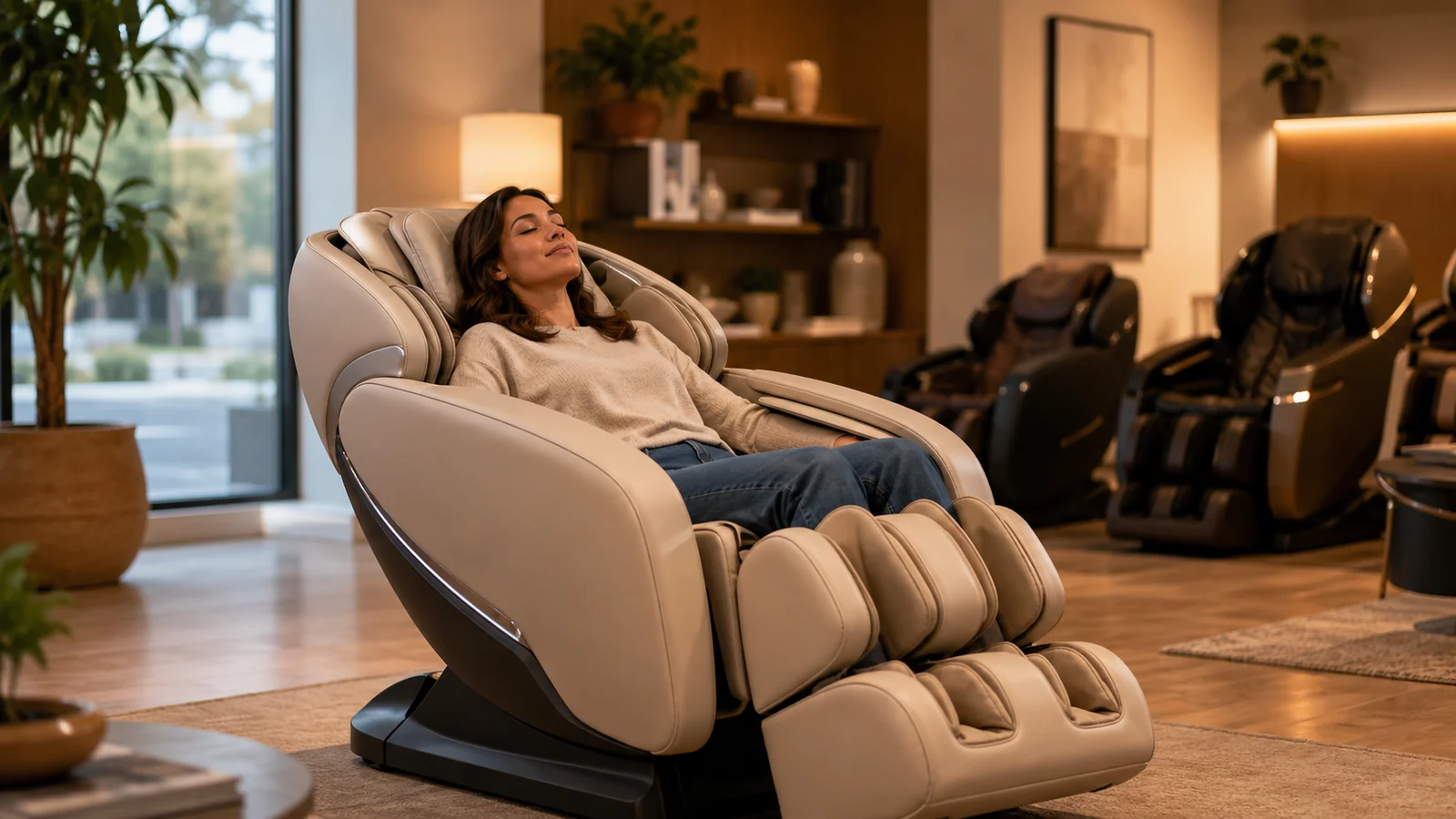
A massage chair is a large, long-lived purchase with moving parts, and the seller often handles your warranty, service, and delivery long after the sale. That makes who you buy from matter as much as which chair you choose. A legitimate showroom should lower your uncertainty — not manufacture pressure.
- It's a high-ticket purchase. The stakes are higher than a typical retail buy, so a calm, transparent process protects you.
- Comfort is personal. Height, build, and pressure preference change how a chair feels, which is why genuine testing access is so valuable.
- Support happens after delivery. Warranty terms, repair turnaround, and who answers the phone shape years of ownership.
- Delivery and installation are real logistics. A 200-pound chair through a doorway and up stairs is a project, not an afterthought.
- Reviews alone aren't enough. Star ratings show broad sentiment; they can't confirm fit, service, or delivery for you.
None of this means a physical showroom is always the right choice. Plenty of buyers do well shopping carefully online with a clear return window. The point is that the same trust signals apply either way — a good showroom simply makes more of them visible at once. (For the trade-offs, see buying online vs. in a showroom .)
- Legitimate showroom
- A seller that can be verified, allows genuine in-person testing when possible, explains warranty, service, and delivery in writing, shows meaningful reviews, and describes chairs in responsible, non-medical terms — without pressure tactics.
- Retailer trust
- How transparent, established, and supportive a seller is across pricing, claims, service, and a verifiable track record. It shapes your experience long after delivery — see how to choose a retailer .
- Purchase risk
- The things that can go wrong after you pay — limited coverage, slow repairs, surprise delivery terms, unclear support — that affect long-term value. Comparing trust signals up front reduces it.
Quick showroom trust checklist
Use this massage chair showroom checklist as you research a store or plan a visit. Tick what you can confirm — it's a thinking tool, not a sign-up, and nothing is saved or sent.
Tick what you can verify as you research — it's a private checklist, not a sign-up. Nothing is saved or sent.
Physical showroom and business transparency
Before anything else, confirm the store is a real, accountable business. Most of this you can verify from home in a few minutes — and it tells you a lot about how the rest of the relationship will go.
Clear address and business identity
Look for a single, consistent business name and a street address you could actually drive to. A legitimate seller doesn't hide where it operates. Cross-check the name across the website footer, contact page, and any listings.
Real showroom photos
Genuine interior photos — the floor, the chairs, the space you'd sit in — are a strong signal. Be cautious if the only imagery is glossy stock photography or manufacturer renders with no sign of the actual room.
Google Business Profile consistency
A maintained Google Business Profile with matching name, address, hours, and photos suggests a store that stands behind its identity. Inconsistent details across the profile, website, and listings are worth a second look.
Here's how to verify a massage chair store before you ever walk in — most of it from home, in a few minutes:
- Address: a real, mappable location you can visit.
- Business name: consistent across the site, contact page, and listings.
- Phone number: a working line where someone answers questions.
- Hours: posted and accurate on the website and profile.
- Real photos: the actual showroom, not stock imagery alone.
- Local presence: a Google Business Profile and any social or community footprint.
- Contact page: clear ways to reach the business in writing.
- In-store reviews: public reviews that mention visiting the showroom in person.
Watch for
No clear address, no real showroom photos, inconsistent business names, an unclear or unanswered phone number, stock imagery only, or hidden location details. Any one of these is a reason to ask more questions before you visit.
Try-before-buy access
The single most useful thing a showroom offers is the chance to sit in chairs the way you actually would at home. Comfort, body fit, pressure, and the feel of the controls vary from person to person, so a legitimate showroom makes testing easy rather than awkward.
- More than one or two chairs to compare across price tiers, not just the one staff want to sell.
- Real time in the chair — a full program, often 15 minutes or more, rather than a rushed demo at maximum intensity.
- Freedom to adjust body scan, intensity, roller width, and recline yourself.
- Honest availability. Not every model will be on the floor, but a good showroom tells you clearly what you can and can't try.
- Try-before-buy access
- The ability to genuinely test a chair in person — sitting a full program, adjusting settings, and comparing models — before committing. A legitimate showroom explains demo access plainly, including which models are available.
Brand and model comparison depth
A multi-brand massage chair showroom can make it easier to compare options side by side, which is genuinely useful when comfort is personal. But a single-brand showroom can be perfectly legitimate too, as long as it's transparent. What matters is whether staff help you understand real differences — fit, use case, warranty, service, and delivery — rather than only reciting feature lists.
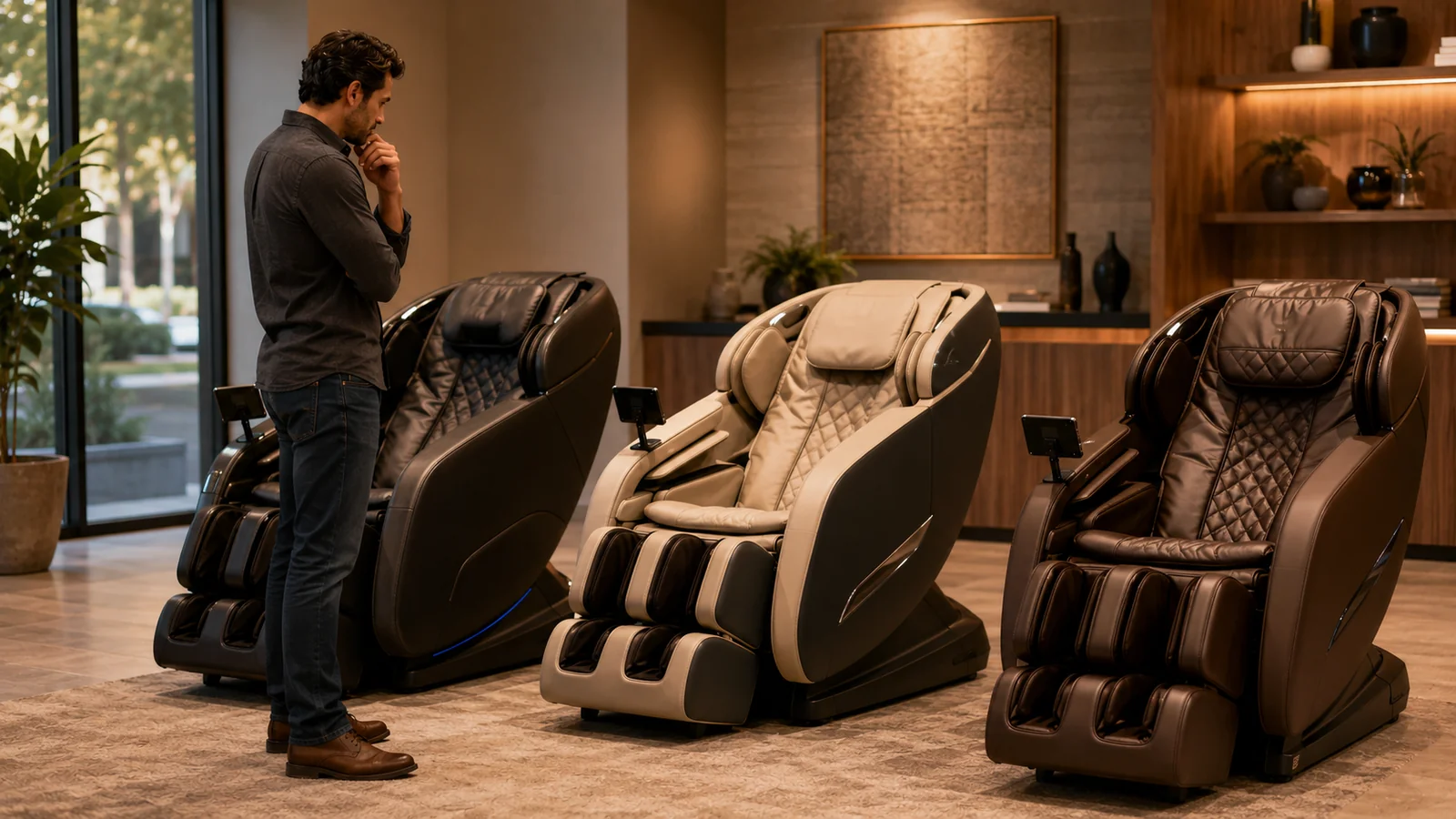
You may encounter these brand names while shopping. They're listed alphabetically to help you recognize the market — not ranked or endorsed, and not all have been tested:
- Bodyfriend
- Cozzia
- D.Core
- Human Touch
- Infinity
- Kyota
- OHCO
- Ogawa
- Osaki
- Panasonic
A good showroom uses brand breadth to help you decide, not to overwhelm you. For a fair way to weigh any brand against the same criteria, see our guide to comparing massage chair brands .
Staff guidance and a no-pressure environment
The clearest line between a legitimate showroom and a high-pressure sales floor is how it treats your time. Genuine guidance helps you decide; pressure tries to decide for you.
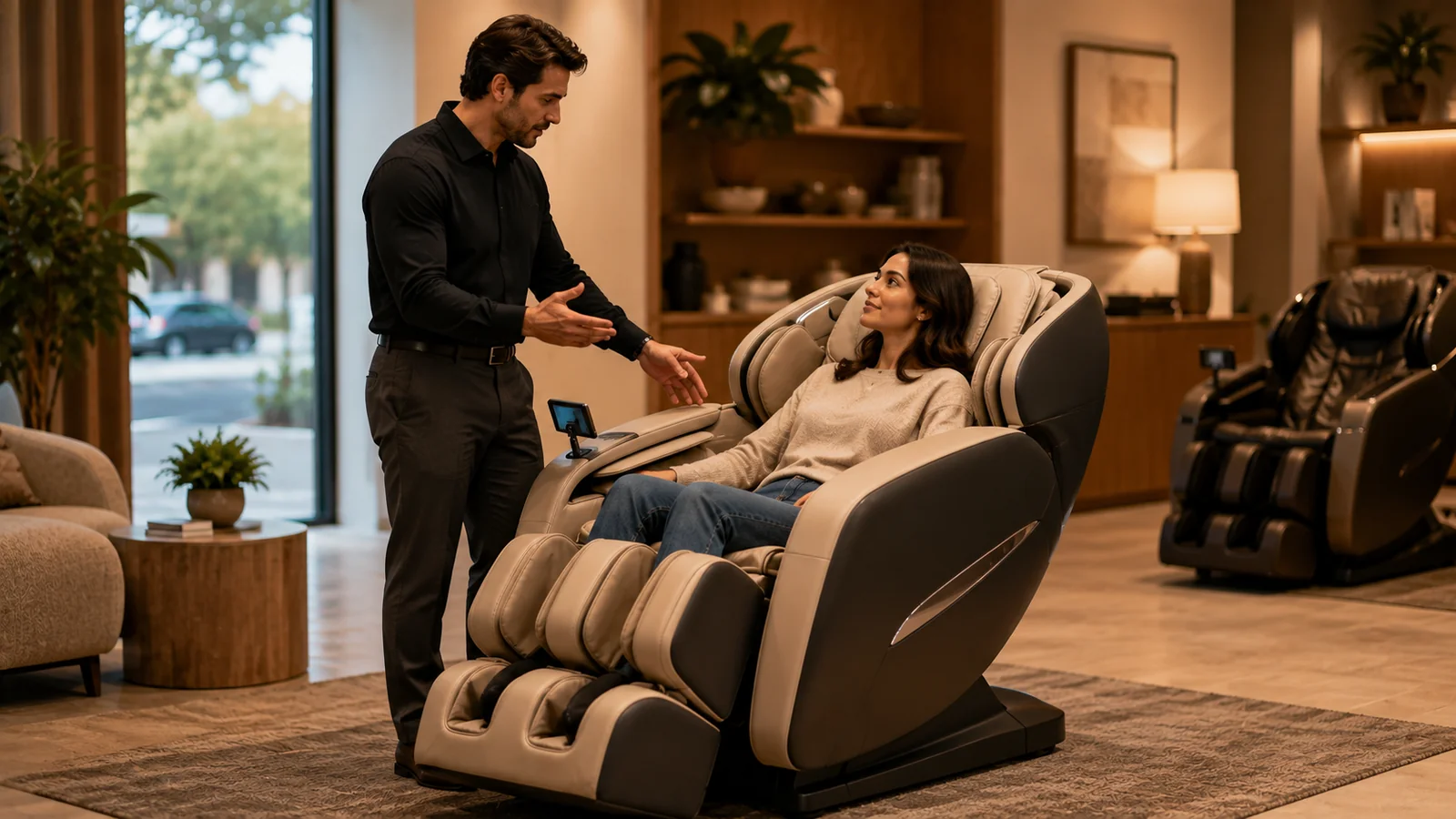
What good, no-pressure guidance looks like
- Asks about your body, your space, and how you'd actually use the chair.
- Explains differences between models clearly, in plain language.
- Talks through warranty, service, and delivery without being prompted.
- Gives you room to compare — and welcomes a spouse or co-decision-maker.
- Is comfortable with you leaving to think it over.
Pressure signals
"Today only" urgency, pushing one model too hard, ignoring fit concerns, vague warranty answers, dismissing your online research, or refusing to explain service and delivery. None of these mean a store is illegitimate on their own — but together they're a reason to slow down and compare elsewhere.
Warranty, service and post-purchase support
A chair is a long-term purchase, so how a showroom talks about coverage matters as much as the chair itself. Legitimate sellers put the warranty in writing and walk you through it without flinching. Vague or shifting answers here are one of the clearest warning signs.
Bring these questions with you — they cover what most people forget to ask until something breaks:
- Who handles the warranty — the retailer, the manufacturer, or a third party?
- What does the warranty cover, for how long, and what's excluded?
- Are parts covered, and for how many years?
- Is labor covered, and for how long?
- Is in-home service available, or must the chair be shipped to a depot?
- How are repairs requested, and what's the typical turnaround?
- Are replacement parts available down the road?
- Is the warranty written clearly, so you can read it before you buy?
Delivery, installation and space-fit transparency
Massage chairs are large and heavy, and delivery is where surprises tend to hide. A legitimate showroom is upfront about exactly what arrives at your door — and confirms the chair will fit your space before delivery day.
Ask these before you commit:
- What is the delivery cost, and is it included or added later?
- What delivery method is used — in-home setup or curbside drop-off?
- Is white-glove delivery available (brought inside, assembled, placed, tested, packaging removed)?
- What happens with stairs or narrow doorways?
- What room clearance is needed for full recline and wall gap?
- What is the installation process, and how long does it take?
- What happens if delivery fails or the chair won't fit?
- What are the return or cancellation terms?
Review quality and local reputation
A star rating shows broad sentiment, but it can't tell you whether a chair fits you or how service actually goes. The signal is in the detail. Read for patterns across many reviews rather than reacting to any single post.
Good review quality signals
- Recent reviews that reflect current models and service.
- Specific detail — staff names, the showroom visit, the delivery experience.
- Mentions of service or warranty follow-through after the sale.
- Thoughtful owner responses to both praise and complaints.
- Detailed customer stories rather than one-line ratings.
Review red flags
Generic one-line reviews, no recent activity, repeated service or delivery complaints, or an unnatural burst of reviews in a short window. Treat reviews as a way to surface questions and spot patterns — not as proof of comfort or fit.
- Review quality
- How useful reviews are, judged by recency, specificity, and whether they describe the chair, the retailer, delivery, and service separately — not just the average star count.
Responsible wellness and medical claim language
How a showroom talks about what a chair does tells you a lot about its honesty. Comfort and relaxation language is very different from treatment-style claims, and a legitimate showroom stays on the right side of that line.
Trustworthy staff describe massage chairs in terms of comfort, relaxation, and the temporary relief of minor muscle tension. Be cautious with claims about chronic pain, recovery, or disease, and ask what evidence supports any wellness claim you hear.
A safe way to frame it
Massage chairs are best evaluated for comfort, relaxation, pressure preference, body fit, and temporary relief of minor muscle tension. They are not a substitute for medical diagnosis or treatment. If you have a diagnosed condition, ask a healthcare professional whether a massage chair is appropriate for you.
- Responsible wellness language
- Marketing and staff descriptions that stay with comfort, relaxation, and minor muscle-tension relief — and avoid implying a chair will diagnose, treat, or cure a health condition.
Retailer Trust Score criteria
When we describe what makes a showroom worth visiting, we look at the same set of criteria every time and apply them consistently. We don't publish a score for any specific store on this page — the framework is here so you can apply it yourself.
- Physical showroom transparency — a verifiable location with real photos.
- Try-before-buy access — genuine in-person testing.
- Brand and model comparison — meaningful choice, explained clearly.
- Staff guidance — helpful, no-pressure, candid about limits.
- Warranty clarity — written terms, parts and labor explained.
- Service support — a clear path to repairs and turnaround.
- Delivery and installation clarity — setup vs. curbside stated up front.
- Review quality — detailed, recent, with owner responses.
- Pricing and financing transparency — no games, no hidden terms.
- Claim safety — responsible, non-medical language.
- Website and Google Business Profile consistency — identity that matches everywhere.
- Showroom verification
- The process of checking a store against consistent, public criteria — location, testing access, warranty, service, delivery, reviews, and claim language — rather than trusting marketing or a single rating.
Red flags before visiting a showroom
None of these guarantees a store is untrustworthy, and most have innocent explanations. But several together are a reason to slow down, ask more questions, and compare other options before you commit.
- Red flag: No clear addressNo verifiable, visitable location.
- Red flag: No real showroom photosStock images only, no view of the actual space.
- Red flag: Vague warrantyVerbal-only or shifting coverage answers.
- Red flag: No service pathCan't say who repairs a chair or how.
- Red flag: Unclear delivery termsSetup vs. curbside surfaces only after you pay.
- Red flag: Exaggerated medical claimsPromises to treat or cure conditions.
- Red flag: Fake urgencyCountdown deals and "today only" pressure.
- Red flag: Pressure-heavy discountsSteep cuts that only hold if you buy now.
- Red flag: Generic reviewsOne-line ratings with no specifics.
- Red flag: No written detailsNothing you can read before buying.
- Red flag: Inconsistent online profilesNames, hours, or addresses that don't match.
Questions to ask before visiting
A few questions, asked by phone or email before you go, will tell you most of what you need to know — and how a showroom answers is itself a signal.
Ask before you go
- Which models are available to try in person right now?
- Can I compare more than one chair in a single visit?
- Who handles warranty and service, and for how long?
- Is delivery included, and is it in-home setup or curbside?
- Is installation included, and what does it involve?
- What happens if the chair doesn't fit my space or doorway?
- Are financing terms clear and in writing?
- What evidence supports any wellness claims you make?
- Can I bring another decision-maker with me?
How a legitimate showroom compares to a caution sign
Use this as a quick reference. It describes what stronger and weaker practice tend to look like — not a score for any store.
| Criteria | Legitimate showroom | Reason to pause |
|---|---|---|
| Location | Verifiable address and real photos | No address or stock images only |
| Demo access | Multiple chairs, full programs, self-adjustment | One chair, rushed 60-second demo |
| Warranty | Written terms, exclusions explained | Verbal-only, vague or shifting |
| Service | Names who repairs and gives a turnaround | "We'll sort it out," no specifics |
| Reviews | Recent, detailed, with owner responses | Generic, sparse, or a sudden burst |
| Delivery | Setup vs. curbside stated before purchase | Details surface only after you pay |
| Claim language | Comfort and relaxation; no disease claims | Promises to treat or cure conditions |
Star ratings vs. review quality
| What you're reading | Star rating alone | Review quality |
|---|---|---|
| Tells you | Broad sentiment at a glance | The actual buyer experience, in detail |
| Service & delivery | Hidden inside one number | Named, with timelines and outcomes |
| Fit for you | Can't show it | Hints from buyers of similar height and build |
| Best used for | A first filter | The real decision |
Key takeaways
- Judge a showroom by trust signals together — location, testing, warranty, service, delivery, reviews, and claim language — not price or stars alone.
- Genuine testing means several chairs, real time in each, and freedom to adjust settings yourself.
- Warranty and delivery terms should be in writing, with clear answers on repairs and setup before you commit.
- Responsible staff describe comfort and relaxation, not cures; pressure and urgency are signals to slow down.
How we evaluate showroom trust signals
We're an independent guide — we don't sell massage chairs, run a showroom, or take payment to rank, rate, or feature anyone. When we describe what makes a showroom worth visiting, we weigh showroom access, try-before-buy availability, business transparency, review quality, warranty and service clarity, delivery and installation clarity, and responsible claim language — held to public correction and disclosure standards. The aim is buyer confidence: a consistent standard for a trustworthy massage chair retailer that you can apply wherever you shop.
Looking for local showroom guidance?
Searching for a massage chair showroom near me — or a massage chair store near me — will surface plenty of results. These guides help you compare them with the same neutral checklist, by region. They're guidance on what to look for, not directories or rankings of particular stores.
California Massage Chair Showroom Guidance
Statewide guidance on what to look for and how to compare before you visit.
Bay Area Massage Chair Showroom Guidance
How to evaluate showrooms across the Bay Area — including Santa Clara, Valley Fair, San Jose, and the wider South Bay — using the same checklist.
Comparing brands during a showroom visit?
A good showroom helps you compare brands and models by fit, comfort, warranty, service, delivery, and responsible claim language — not by hype. We describe brands neutrally and never rank them, and not every brand has been tested.
Frequently asked questions
What makes a massage chair showroom legitimate?
A legitimate massage chair showroom is easy to verify, lets you test chairs in person when possible, explains warranty and service in plain language, is upfront about delivery and installation, shows meaningful customer reviews, and uses responsible wellness language rather than medical promises. Judge it by these trust signals together, not by price or a star rating alone.
How do I know if a massage chair store is trustworthy?
Confirm a real address and consistent business identity, look for genuine testing access, and ask who handles warranty and service. Trustworthy stores answer specific questions clearly, put terms in writing, and never rely on pressure. Vague answers about repairs, delivery, or coverage are a reason to slow down and compare other options.
Should a showroom let me try chairs before buying?
Whenever possible, yes. Comfort and body fit are personal, so sitting a full program — often 15 minutes or more — tells you what specs can't. Not every model will be on the floor, but a legitimate showroom explains demo availability clearly and encourages unhurried testing rather than a rushed, high-intensity demo.
Are Google reviews enough to trust a massage chair showroom?
Not on their own. A star rating shows broad sentiment but can't confirm fit or service for you. Read for patterns across many reviews, favor recent and detailed ones, and look for mentions of delivery, warranty, and service plus thoughtful owner responses. Use reviews to surface questions, not as proof of comfort.
What warranty questions should I ask at a showroom?
Ask who handles the warranty, what it covers and excludes, how long parts and labor are covered, whether in-home service is available, how repairs are requested, the typical turnaround, and whether replacement parts stay available. A legitimate showroom puts these terms in writing so you can read them before you buy.
What are red flags in a massage chair showroom?
Watch for no clear address, no real showroom photos, vague warranty answers, no service path, unclear delivery terms, exaggerated medical claims, fake urgency, pressure-heavy discounts, generic reviews, and inconsistent online profiles. Any one may be innocent, but several together are a reason to ask more questions before committing.
Is a multi-brand massage chair showroom better?
A multi-brand showroom can make side-by-side comparison easier, which helps when comfort is personal. But a single-brand showroom can be perfectly legitimate too, as long as it's transparent. What matters is whether staff explain real differences in fit, warranty, service, and delivery — not how many logos are on the floor.
How do I verify a massage chair dealer?
Check a verifiable address, a consistent business name, a working phone number, and accurate hours. Confirm a Google Business Profile that matches the website, look for real showroom photos and detailed reviews, and ask for written warranty, service, and delivery terms. Consistency across all of these is the core of showroom verification.
What medical claims should a showroom avoid?
Responsible showrooms describe comfort, relaxation, and temporary relief of minor muscle tension. They avoid implying a chair will diagnose, treat, or cure conditions. Be cautious with promises about chronic pain, recovery, or disease, and ask what evidence supports any wellness claim. For a diagnosed condition, consult a healthcare professional.
Where can I find local showroom guidance?
Our regional guides apply the same neutral checklist to specific areas — see the California showroom guidance and the Bay Area showroom guidance, which covers Santa Clara, Valley Fair, San Jose, and the wider South Bay. They're guidance on what to compare, not directories or rankings of specific stores.
Before You Visit
Compare showroom standards before you visit
A short checklist turns any showroom visit into a calm, confident comparison — wherever you decide to buy.
No sign-up required. MassageChairsTested.com is an independent guide and does not sell massage chairs.
Last updated: June 2026 · Editorial standards · Disclosure